
Learning to Sit With Grief: Inside the Grief Stewardship Workshop
A two-Sunday workshop for people who are already the ones others turn to in a loss. Learn how grief looks across Singapore's faith communities, and how to lead a small-group conversation with care. Free, 20 places, apply by 5 October.

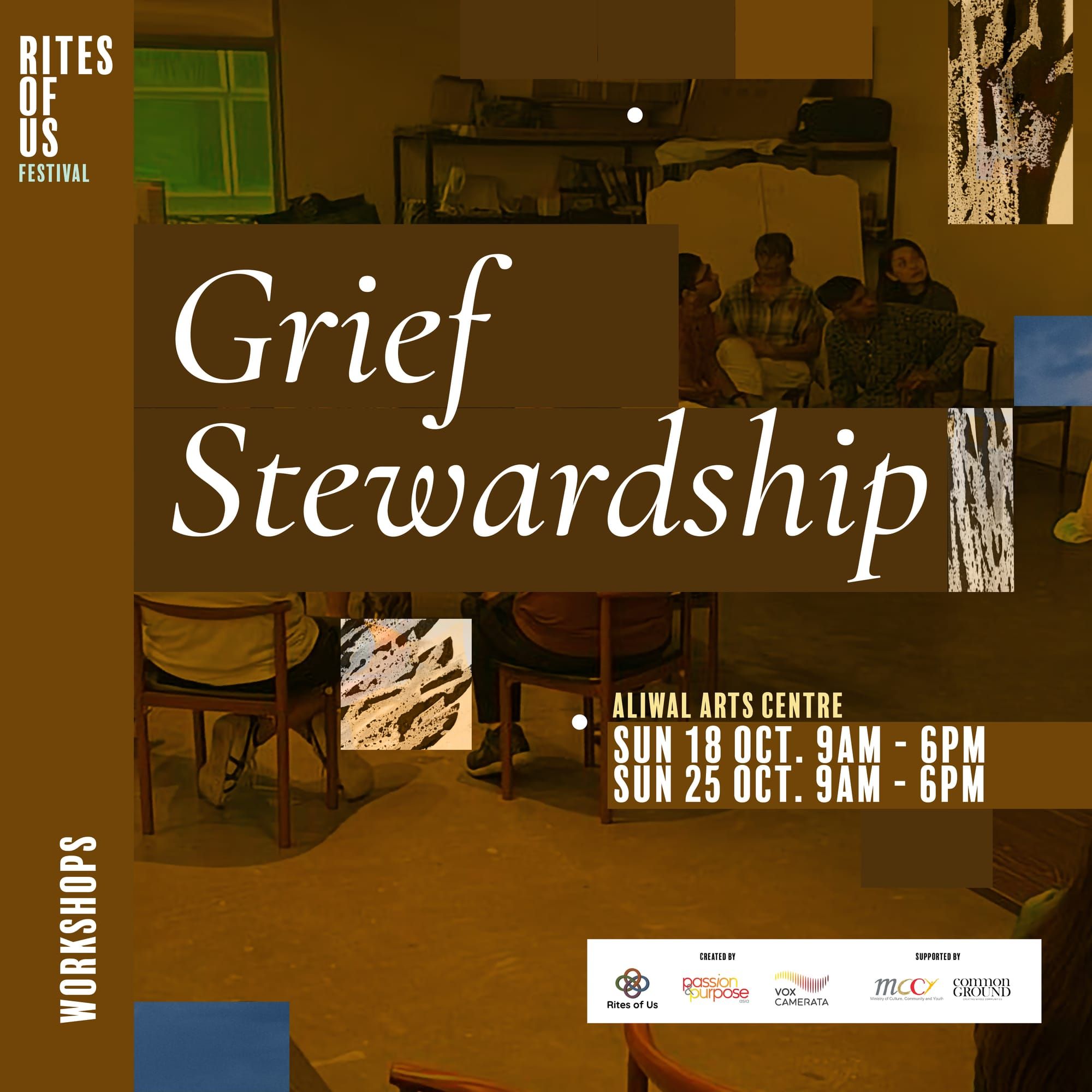
Most of us learn how to grieve inside our own community and nowhere else. We know what our family does when someone dies. We rarely know what the family next door does, and we worry about getting it wrong. So we stay away, or we say the wrong thing, or we say nothing at all.
The Grief Stewardship Workshop takes on that gap. It runs over two Sundays this October, and it is built for people who are already the ones others call when a loss happens: caregivers, teachers, faith workers, social service practitioners, and volunteers. If people in your community turn to you when they are hurting, this workshop is for you.
What it is, and what it is not
The workshop does not train counsellors or psychologists. You will not leave with clinical skills, and we will not ask you to act as a therapist.
You will leave with three things. The first is a clearer relationship with your own experience of loss, which can mean a death, a breakup, a job that ended, or a move that cost you a home. The second is a working understanding of how grief looks in Singapore's different faith and cultural communities. The third is the practical skill to lead a small-group conversation about grief with care.
Two Sundays, one week apart
Sunday 18 October: Foundations
The day opens with a circle. The group sets its agreements together: confidentiality, the right to pass, and the difference between sharing and disclosing. From there the day moves through why so many of us avoid grief conversations, and what we leave unsupported when we do. Alexander Lee, a psychotherapist, guides the group through how grief shows up in the body, the mind, and our relationships, and why it does not follow a straight line.
Later, participants write about a loss of their own and talk it through in pairs. Then each person spends three or four minutes telling the group what their community does when someone dies. The focus stays on practice, not theology. What does the family do? What does the community do? What would a visitor see if they walked in? We expect this to be the richest stretch of the first day, because it puts real practices from real households in front of people who have never seen them.
The day ends with a lesson that sounds simple and is not: how to stay with someone in grief without trying to fix it.
Sunday 25 October: Application
The second Sunday starts with what stayed with you during the week. Then Dr. Shahril Salleh guides the group through death, funeral, and mourning practices across Singapore's major faith communities. You will learn what each tradition holds sacred, what a guest would encounter, and which well-meant gestures land badly.
The afternoon turns to practice. Participants work through three scenarios: attending a wake in an unfamiliar tradition, supporting a grieving colleague whose culture expresses grief differently from yours, and leading a small-group conversation among people of different faiths. The day closes with facilitation skills, from opening a session safely to closing it so that everyone leaves supported rather than exposed. Each person names one step they will take in their own community within three months.
Why a week in between
The first Sunday brings up difficult material, and the week between the two days is deliberate. It gives you time to absorb what surfaced, notice what you are still carrying, and arrive on the second Sunday ready to work at a practical level.
What happens next
Graduates put their training to use straight away. During the Rites of Us community festival on 31 October and 1 November, some of the workshop graduates will lead CHECKING IN, a series of small-group grief conversations open to the public. Each graduate leads a group with a supervisor close by.
The learning does not stop at the festival. Every graduate receives a take-home resource pack to adapt for their own community. We will check in with the cohort in January 2027, and graduates join a community of facilitators who share resources and support each other between programme years. After the festival, we will publish the workshop materials online as a free resource.
Who leads it
Dr. Shahril Salleh, Artistic Director of Vox Camerata Limited, leads the sessions on intercultural practice and interfaith understanding. Alexander Lee, an independent psychotherapist with experience at Samaritans of Singapore and TOUCH Community Services, leads the sessions on grief responses and the limits of non-clinical care.
How to join
- Dates: Sunday 18 and Sunday 25 October 2026, 9:30am to 6:00pm both days
- Venue: Aliwal Arts Centre
- Cohort: 20 participants, so places are limited
- Cost: Free
- Apply by: Monday 5 October 2026
- Apply here: https://forms.cloud.microsoft/r/E4rnA4nPes
This is an application, not open registration. We are building a group with many different backgrounds, because the learning depends on people meeting perspectives unlike their own. We will confirm places by 10 October 2026 at the latest.
Rites of Us is produced by Passion & Purpose Asia and Vox Camerata Limited, with support from the MCCY Harmony Fund.